The programme's overall objective is to reduce greenhouse gas emissions from the forest sector while improving the livelihoods of Indonesia's poor rural communities. To achieve this goal, the Programme team will assist the Indonesian government to design and implement legal, policy and institutional reforms for the conservation and sustainable management of forests, at local, provincial and national level. Support to REDD demonstration activities are a key feature of the Programme, providing decision-makers with experience of how REDD can be implemented "on the ground".
In its first phase until the end of 2012, GIZ will work with the Ministry of Forestry on national policy and sector strategies, to gear these strategies towards the requirements of emission reductions. Effective stakeholder participation is a critical success factor in all planning and strategy development processes.
The team will assist to devise or adapt regulations for forest administration reform and future REDD mechanisms, supporting pilots of innovative emission reduction schemes in selected districts of Kalimantan. National, regional and international discussion and strategy development will benefit from feedback about successes and challenges "on the ground".
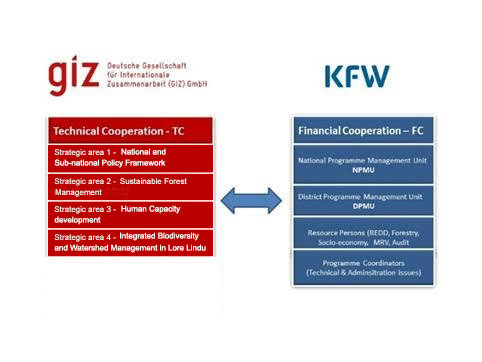
The FORCLIME Programme focuses on the relationships between national, provincial and district governments in making land and resource use decisions. A team of international and Indonesian advisors strengthens institutional capacities for managing and monitoring forests, where the decentralization process has left uncertainties in mandates between agencies and administrative levels. The establishment of forest management units (FMUs), to bring the management of different forest categories from 'protection forest' to 'production forest' under one roof, is crucial to this reform. The establishment of FMUs involves the division of monitoring and inspection tasks from operational tasks and thus will place management responsibility closer to the field.
The FC component will contribute to reducing emissions from deforestation and forest degradation (REDD). Hereby, KfW aims at the implementation of strategies for forest conservation and sustainable forest management resulting in reduced GHG emissions from the forest sector and improved living conditions of the impoverished rural population. With its commitment in the FORCLIME Programme, KfW seeks to demonstrate the viability of a pro-poor REDD-mechanism in Kalimantan.
Therefore, KfW uses a district based approach in order to prepare selected pilot areas for national and international carbon markets. KfW finances measures to achieve readiness in three districts of Kalimantan (Kapuas Hulu, Malinau, Berau), realizes an investment programme for REDD demonstration activities and develops an innovative and fair incentive payment scheme. All KfW efforts are closely aligned with different project partners, such as government institutions, communities, NGOs, private sector and concession holders.
The FC module includes the following measures:
Last Updated on Thursday, 05 January 2012 07:44
Road show to develop the 2012 work plan for FORCLIME Component 2In the first two weeks of February FORCLIME Component 2 conducted workshops in each of the three pilot districts in order to prepare the FORCLIME annual work plan and align it with the district planning. In each location this “Road Show” was attended by representatives from the District Forest Service, local agencies at district level,... Read more... |
16-21 April 2012. Sixth International Conference on Community Based AdaptationHanoi (Ha Noi), Viet Nam |
11 May 2012. International Seminar "Assessing Forest Governance in a Context of Change" Sarajevo, Bosnia HerzegovinaThe objective of the conference is to meet scientists and other experts to discuss the experiences in assessing the governance of the forest sector in various places of the world. Read more... |